Victoria’s Workout Blog
Workout #1- Week 1
Workout #1- Week 2
(for some reason, the video seems to run too fast and doesn’t show my repetitions clearly)
Get new content delivered directly to your inbox.

Workout #1 Questions
1. I felt that since the exercise was being done for 1 minute, the intensity was very high because I pushed myself to do as many reps as I could. By the end of the 1 minute challenge, I was breathing quite heavily, as I did not take breaks between the exercises.
2. I liked the plank the most because it is a full body exercise while, in my opinion, allows me to catch my breathe ad concentration mores on my body’s positionment. Instead of many repetitions, the movement requires you to stay still and stresses the importance of the form.
3. I disliked the split squat jump because it requires, jumping, stability, and is leg work, for the most part. I struggle most with my stability and balance, and so hopping to interchange one leg for the other was quite difficult.
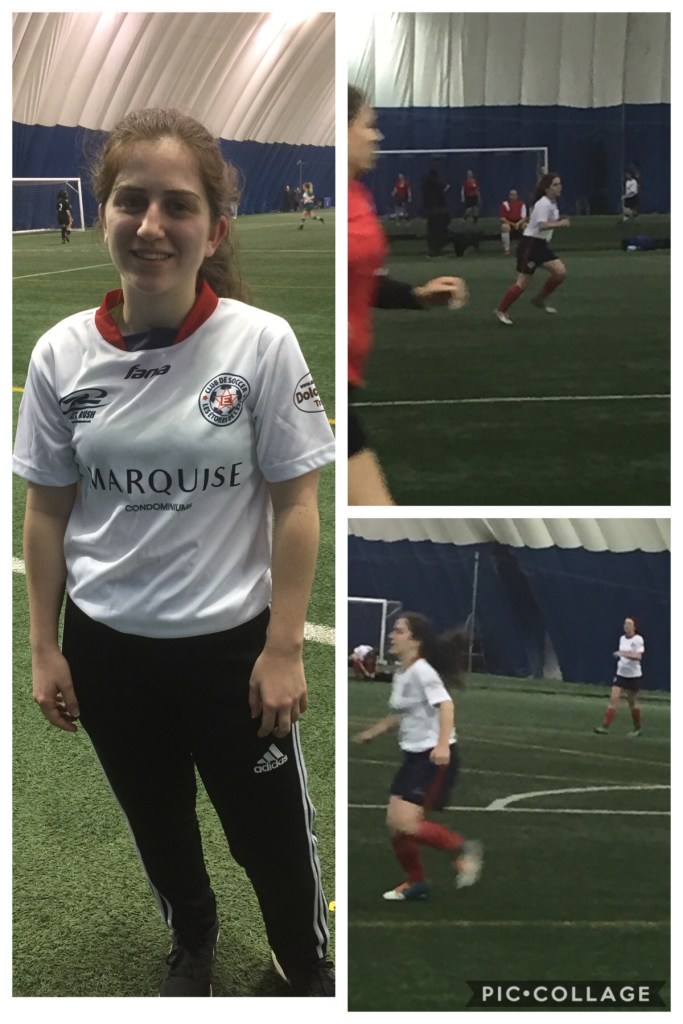
4. Seeing that I have a very busy schedule, with school and soccer, I found it difficult to make time to workout however, after the first week, I started a routine, where I would workout Saturday and Sunday morning, to feel more productive and energized throughout the day.
5. The first exercise that works the quadriceps and hamstrings are squats, and to increases the intensity, as in the 1 minute challenge, you could do jump squats. Lunges are also great at working the gluteals and the quadriceps. Lastly, write evident in its name, the hamstring bridge works the hamstring muscles and the glutes.
6. An abdominal workout from the workout is the plank, and this can include the side plank, which works the full body. Leg raises are also abdominal workouts, as well as the Russian twist with a medicine ball for a greater resistance.
7. Dead lifts and kettlebell swings are great back exercises, specifically, for working the upper back. Push ups and chest flyes, that require a bench press and weights, are exercise options that works the chest
8. Exercise options that work the shoulder/deltoid muscles are the bent-over dumbbell lateral raise, the standing dumbbell fly and chair dips.
Workout #2- Week 3

Workout #2- Week 4

Workout #2 Questions
1.I prefer the tabata workout because the rests in between help me to catch my breath and I end up working so much harder in the 20 seconds that I have. I push myself and give it my all in those 20 seconds whereas in a minute, I will get tired quicker and slow down. Comparing weeks 1 and 2 with weeks 3 and 4, my body worked harder during the tabata workout because I would do more in the 3 rounds of 20 seconds than trying to do the exercise for one minute straight. Also, the 20 seconds motivated me to try to do the same amount of repetitions of the same exercise in the 3 sets, so I created a goal for myself.
2. I am a very anxious person and so before working out I am usually stressing over trivial things and my mind is filled with constant worries. In a way, while I am completing the physical activity, my mind forgets all these thoughts that have been consuming me, and I am finally enjoying myself while focusing on the task at hand. I use physical activity as a stress outlet. After the workout, I am usually still stressed when looking at my busy schedule, however, I feel more productive, motivated and take a more positive approach when looking at life.
3. What motivates me to follow the workouts is knowing how I will feel afterwards. I regularly exercise because I know that once I complete my workout I feel accomplished and it helps me have a more productive day. Also, I view working out as something enjoyable rather than a task, and so it helps distract me from my stresses. For this reason, I am very motivated to workout in the morning because it is a great way to start my day, and can help me mentally and physically.
4. I should be eating 7 servings of fruits and vegetables per day. At the moment I am only getting around 5-6 servings per day, which is just under what is recommended by Canada’s Food Guide. To ensure I have enough I would make it more easily accessible for me to eat fruits and vegetables on the go, for example, by bringing more to school as snacks. Also, to reach 7 servings, I can add 1 serving of fruit in the morning and another serving of vegetables when having supper.
5. The 6 essential nutrients are water, vitamins, minerals, protein, fat, and carbohydrates.
6. 4 carbohydrates we should be eating more of are oats, quinoa, fruits and vegetables.
7. 4 carbohydrates we should reduce the intake of are syrups, honey, sugar, and fructose.
8. A nutrition improvement for health improvement is increasing our water intake by replacing carbonated drinks and sugary fruit juices which provide “empty” calories with water instead.
Workout #3- Week 5
Workout #3- Week 6
Workout #3 Questions
1. Completing all 8 exercises twice was a high intensity workout because I motivated myself to do them without stopping in between the sets. By the end of the sets, I was breathing heavily. I did not stop, however the burpees, in my opinion, were the most difficult to complete in succession.
2. Doing exercises 3 times a week at home has actually been quite easy, due to the break from school. Now, I am able to strictly follow and complete a workout about once every two days and they are convenient because I am working my full body while only taking about 30 minutes of my day.
3. A warm-up is important as it prepares the body for the workout by increasing the body temperature, oxygen supply to the muscles and muscle elasticity to prevent muscle and joint injury. A successful warm-up will include 5-8 minutes of increasing the body temperature and ensuring the joint range of motion is well stretched..
4. By doing workouts 3 times a week, and following a strict routine, I have noticed that my legs are more toned and I am able to hold exercises for longer or complete successive repetitions without getting tired.
5. Regular participation in physical activity will decrease LDL (bad) and increase HDL (good) cholesterol levels, will decrease obesity, help control diabetes, and will strengthen one’s immune system. All these benefits will help prevent coronary heart disease.
6. Psychological benefits of regular participation in physical activity are that it relieves tension and stress, it will improve sleep habits, improves self-image and self-confidence and will decrease mood swings and irritability.
7. Muscular conditioning is key to a healthy body composition because it can aid in weight loss and weight maintenance to aid in the prevention of obesity, as well as increases one’s metabolism and will increase caloric expenditure which will decrease your body fat while increasing muscle mass.
8. The child’s pose stretch will improve posture by helping to relive tension in the lower back and neck. The side plank will also develop a proper posture by maintaining the neutral alignment of your spine and legs. Lastly, when performing a regular plank correctly, it will improve our posture by keeping our back straight.
Workout #4- Week 7
Workout #4- Week 8
Personal Workout
 23victoriaynsua